
A shipyard is a factory that cannot behave like one. The yards that improve are the ones that adapt lean thinking to a product that is never quite repeated.
Chapter 1: Introduction
The sea carries the vast majority of global trade. By volume, over eighty percent of goods move by ship. By value, the share is lower but still enormous. This simple fact gives shipbuilding strategic weight. A shipyard is where steel, machinery, electronics, and human skill come together to produce assets that operate for decades. When yards run poorly, the effects ripple outward. Deliveries slip. Costs rise. Shipowners lose revenue. Navies lose readiness. Ports and supply chains feel the delay.
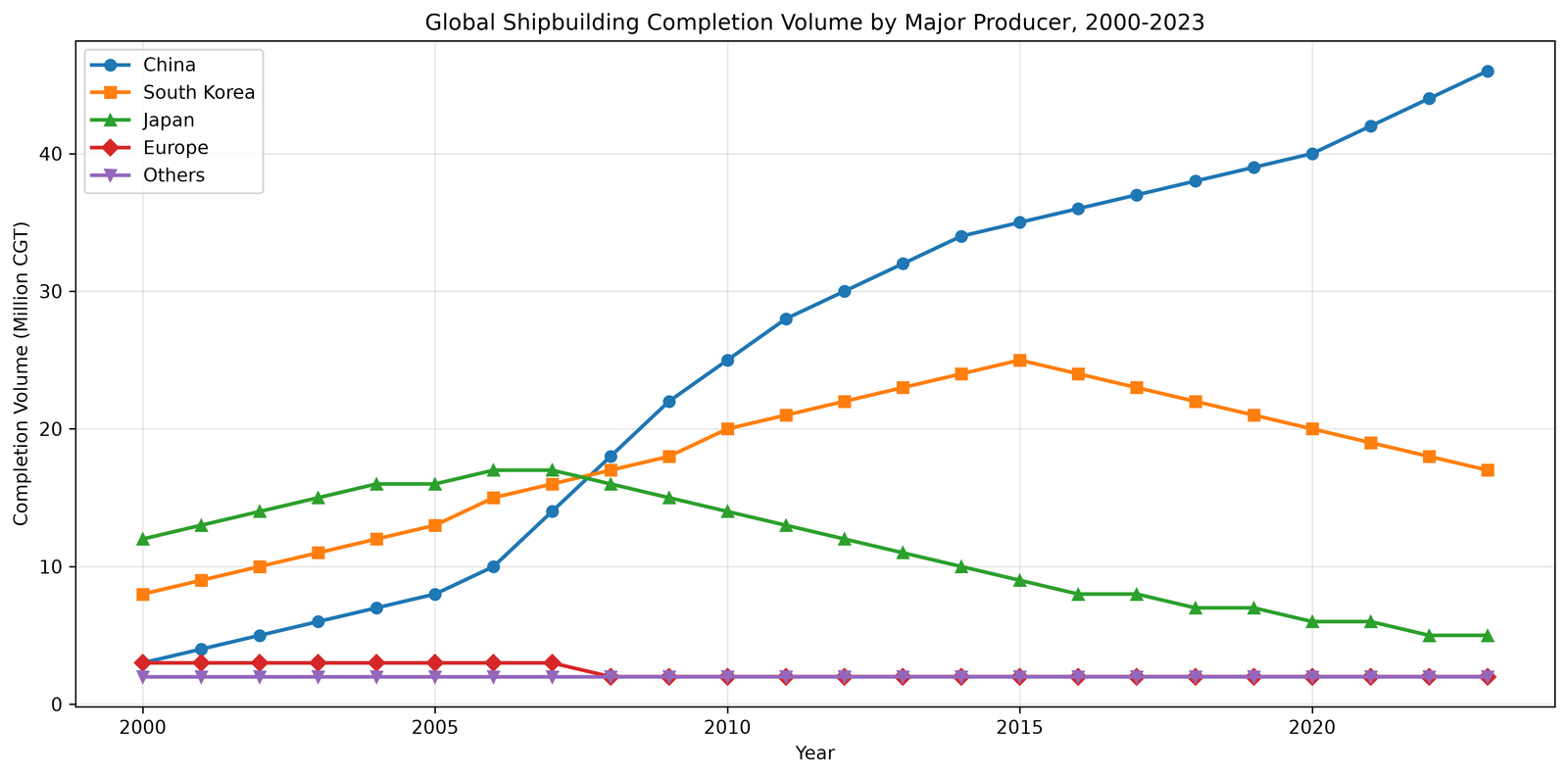
For much of the twentieth century, shipbuilding was a symbol of industrial power. Yards in Europe, Japan, and later South Korea and China grew into massive complexes. Today, the industry is concentrated. China, South Korea, and Japan dominate commercial ship construction. European yards have largely moved toward specialized vessels: cruise ships, ferries, offshore units, and naval craft. The United States maintains a smaller but strategically important naval and Jones Act commercial base. In every region, the same pressure exists. Yards must build more efficiently, with fewer defects, shorter schedules, and lower environmental impact.
This is easier said than done. A shipyard is not an automobile plant. Cars roll off a line by the thousands. A ship is often a one-off. Even when a yard builds a series of similar vessels, each hull is a prototype in important ways. Design changes arrive late. Supply chains stretch across continents. Welding, piping, electrical work, and outfitting compete for the same cramped spaces. Weather affects outdoor work. Cranes become bottlenecks. A single delayed valve can hold up a whole compartment.
Other industries faced similar problems and changed. Automotive, aerospace, and electronics adopted lean thinking, statistical process control, and digital planning. Shipbuilding has adopted some of these methods, but usually in patches. A yard may run a 5S program in one workshop while another area remains disorganized. A planning department may use simulation while the shop floor still relies on paper travelers. The gap between what is possible and what is common is the subject of this essay.
The essay examines two connected themes. The first is shipyard design for efficiency. This includes layout, material flow, workstation placement, and the use of quantitative methods to test designs before construction begins. The second is the application of LEAN principles in shipbuilding. LEAN began in manufacturing, but it cannot be copied directly into a yard. It must be adapted to project-based production, long cycle times, and engineer-to-order workflows. The essay asks what works, what does not, and why.
The structure is as follows. Chapter 2 looks at the physical logic of shipyard design. It covers historical layouts, modern typologies, and the trade-offs between flow and flexibility. Chapter 3 moves into quantitative methods. It discusses Systematic Layout Planning, discrete event simulation, and optimization algorithms, with evidence from real yard studies. Chapter 4 defines LEAN in a shipbuilding context. It translates the seven wastes into yard terms and explains why tools like value stream mapping and takt time need modification. Chapter 5 presents case evidence from shipyards in Pakistan, Indonesia, and India, along with panel assembly line improvements. Chapter 6 examines barriers to LEAN adoption. Chapter 7 considers the digital layer, including Industry 4.0, digital twins, and Lean 4.0. Chapter 8 synthesizes the findings and looks forward.
One point should be made at the start. Efficiency in shipbuilding is not only a matter of speed. It is also a matter of safety, quality, and resilience. A yard that rushes without discipline creates rework, injuries, and waste. A yard that plans carefully, moves material smoothly, and empowers workers to improve processes can deliver better ships at lower cost. That is the promise of good design and LEAN thinking. The rest of this essay examines how close the industry has come to that promise.
Chapter 2: The Physical Logic of Shipyard Design
A shipyard is a factory, but it does not look like one. There is no long assembly line under a single roof. There is no steady rhythm of identical units moving past fixed stations. Instead, there are enormous open areas, towering cranes, dry docks, fabrication sheds, and blocks of steel that can weigh hundreds of tons. The product is so large that the factory must be built around it, not the other way around. This physical reality shapes everything about how a shipyard works. Before any discussion of lean tools or digital systems can be useful, the basic layout of the yard must make sense.
2.1 Historical Evolution of Shipyard Layouts
Shipbuilding is one of the oldest industries in the world, and for most of its history, the layout of a yard was simple. Ships were built on building berths, which were inclined platforms running down to the water. Timber and planking were brought to the berth, and the ship took shape in place. The yard was essentially a collection of berths along a riverbank or shoreline, with storage areas for materials nearby. The ship did not move until it was launched. Everything came to the ship.
That model began to change with the shift from wood to iron and then steel. Metal ships were larger, heavier, and more complex. Working on a single berth for the entire construction period became impractical. The modern solution emerged gradually: prefabrication. Instead of building the entire hull in one place, yards began to fabricate smaller sections, or blocks, in workshops away from the berth. These blocks were then transported to the building site and joined together. This change, which accelerated in the mid-twentieth century, transformed the shipyard from a static construction site into a flow-based production system.
The physical method of getting the ship into the water also evolved. Early dry docks, or graving docks, were used for shipbuilding as far back as the sixteenth century in Venice, and for large naval vessels in the eighteenth century. But dry docks were expensive to build and maintain. Slipways, which were cheaper, remained the dominant method for commercial shipbuilding for a long time. End launching, where the ship slides stern-first into the water, was the most common approach until the 1960s. Side launching was used in some locations, particularly on the Great Lakes and in parts of Europe, where the waterway was narrow.
The decisive shift came in the 1960s, when shipyards began to be built specifically for building in dry docks rather than on slipways. This change was driven by the increasing size of ships and the adoption of block construction. A dry dock offers a level floor, better crane access, and more controlled conditions than an inclined slipway. It also allows the ship to be built in a series of blocks that are lifted into place, rather than assembled piece by piece.
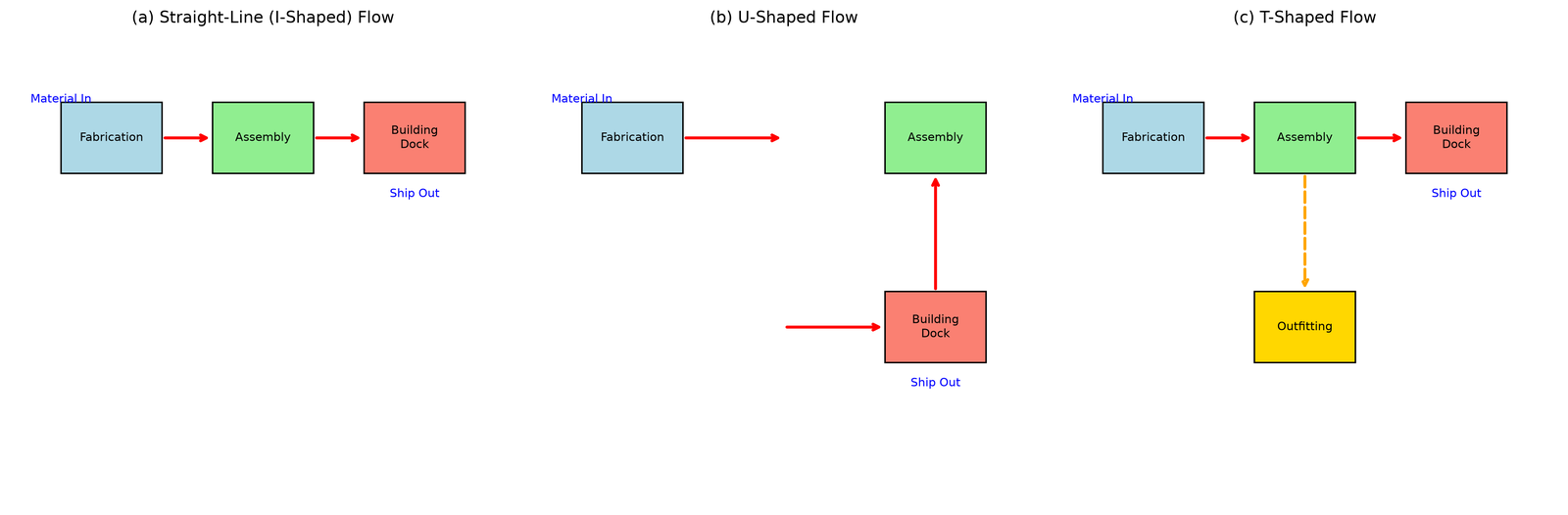
The most influential development in shipyard layout during this period came from Japan. Japanese yards developed what is often called the deep, narrow, or straight-line flow layout. The logic was simple: material should enter the yard at one end, move through fabrication and assembly in a linear sequence, and arrive at the building dock at the other end. The fabrication shop, assembly shop, and building dock were arranged in a straight line, with outfitting shops and the wharf running parallel to the dock. This arrangement minimized backtracking and cross-hauling, which are the enemies of efficient material flow.
This straight-line model required a site with inland depth. Not every yard had that. Where the land was constrained by hills, cliffs, or existing development, yards were squeezed along the shoreline and stretched out laterally. This produced what is sometimes called the wide, lateral, or turning flow layout, where material moves along the shore and then turns at an angle to reach the berths. The turning flow layout was less efficient for block construction, but it was the only option in many locations.
The straight-line concept also gave rise to two common variations: the T-shaped and U-shaped layouts. In a T-shaped yard, the main flow runs in a straight line, but a secondary flow branches off at a right angle. This can be useful when a yard has multiple building docks or when outfitting work needs to be separated from hull construction. In a U-shaped yard, the flow enters the site, moves through production, and then returns toward the waterfront, often because the available land is a narrow strip along the water. The U-shape allows a long production flow within a compact site, but it can create congestion if not carefully managed.
2.2 Layout Typologies and Their Trade-Offs
The choice of layout is not a matter of taste. It is a response to the site, the product mix, and the production philosophy of the yard. Each typology has strengths and weaknesses, and the right choice depends on what the yard is trying to build and how much land it has to work with.
The straight-line, or I-shaped, layout is the purest expression of flow thinking. Material enters at one end and exits at the other with minimal turning. This minimizes transport time, reduces the risk of collisions between material movements, and makes it easier to schedule production because the sequence of operations is physically embedded in the layout. The straight-line layout is best suited to yards with a deep site and a relatively stable product mix. If the yard builds similar vessels in series, the straight-line flow can approach the rhythm of a production line.
The U-shaped layout is a response to space constraints. It allows a long flow path within a site that is not deep enough for a straight line. Material enters, moves through production, and then turns back toward the waterfront. The U-shape can work well in yards that build smaller vessels or that have a waterfront location with limited inland depth. However, the return leg of the U can create conflicts between incoming raw material and outgoing finished blocks if the two flows are not separated. Careful zoning is essential.
The T-shaped layout is more complex. It combines a straight-line main flow with a branch that leads to a secondary area, often outfitting or painting. The T-shape can be useful in yards that have multiple building docks or that need to separate hull construction from outfitting work. But the branch point is a potential bottleneck. Material moving into the branch must not interfere with the main flow, and the scheduling of the two streams must be coordinated.
A more recent development is the use of optimization methods to generate layouts that do not fit neatly into any of these traditional categories. A 2025 study by Kafali used fuzzy logic and simulated annealing to generate layout options for a shipyard, producing U-shaped, L-shaped, and I-shaped arrangements for profiled panel production, as well as an almost star-shaped branched arrangement for sub-block production. The star-shaped arrangement is particularly interesting because it does not follow a single linear flow. Instead, multiple production streams radiate from a central point, which can reduce travel distances for certain types of blocks but requires careful coordination to avoid congestion at the center.
The choice between these layouts is not simply a matter of picking the most efficient one on paper. It depends on the yard's product strategy. A yard that builds large, complex vessels with extensive outfitting needs will have different layout requirements from a yard that builds simple bulk carriers in series. A yard that repairs ships as well as builds them must accommodate a different flow pattern entirely, because repair work is unpredictable and often requires the vessel to remain in place while work is done around it.
2.3 The Workstation Arrangement Problem
Within the overall layout of the yard, the arrangement of individual workstations is the most consequential design decision. A workstation is not just a place where work happens. It is a node in a network of material and information flows. If the workstations are arranged poorly, material will travel farther than it needs to, workers will walk between distant points, and bottlenecks will form at the interfaces between stages.
The factors that influence workstation placement fall into two broad categories: qualitative and quantitative. Qualitative factors include the relationships between activities. Some workstations need to be close together because they share equipment, personnel, or information. Others need to be separated because they involve hazardous processes, noise, or vibration. A painting station, for example, should not be adjacent to a welding station, because the fumes and the fire risk are incompatible. Quantitative factors include the volume and direction of material flow between workstations. A workstation that receives a high volume of material from another station should be located close to it, to minimize transport time and cost.
The traditional approach to workstation arrangement relied on the experience of yard planners. They knew from years of practice which activities belonged together and which needed to be kept apart. But as yards have grown larger and product mixes have become more complex, experience alone is no longer sufficient. The number of possible arrangements is enormous, and the trade-offs between flow efficiency, safety, and flexibility are difficult to evaluate by intuition.
Modern layout planning uses structured methods to handle this complexity. One approach is to assign a proximity rating to each pair of workstations. The rating reflects how close the two stations should be, based on both qualitative and quantitative factors. Fuzzy logic is well suited to this task because it can handle the imprecision of human judgments. A planner might say that two stations should be "very close" or "moderately close," and fuzzy logic can translate those linguistic terms into numerical values that can be used in optimization.
Once the proximity ratings are established, the problem becomes one of finding the arrangement that best satisfies them. This is an optimization problem, and it is usually too complex to solve by hand. Metaheuristic algorithms such as simulated annealing and genetic algorithms are used to search the space of possible layouts. Simulated annealing, in particular, has been shown to perform well on shipyard layout problems. A study comparing genetic algorithms and simulated annealing for unequal-area facility layout in shipyards found that simulated annealing achieved an efficiency of 23.473 percent, compared to 14.592 percent for the genetic algorithm. The difference is significant, though it should be noted that the performance of any algorithm depends on the specific problem and the constraints involved.
Safety is an increasingly important factor in workstation arrangement. Historically, layout planning focused on production efficiency, with safety considered as a secondary constraint. But the incorporation of safety into the layout problem is now recognized as essential. The proximity of workstations affects the risk of accidents. A workstation that handles heavy loads should not be placed where workers from other stations are likely to walk underneath. A station that produces sparks or fumes should be separated from stations that handle flammable materials. The 2025 study by Kafali explicitly incorporated risk as a factor in the proximity rating, alongside activity relationships and material flow. This is a significant step forward, because it treats safety not as an afterthought but as a design variable that shapes the layout from the beginning.
2.4 The Site as a Constraint and an Opportunity
No discussion of shipyard layout is complete without acknowledging the role of the site itself. A shipyard cannot be built just anywhere. It needs deep-water access to the sea, sufficient land area for fabrication and assembly, and transport links for incoming materials and equipment. Most shipyards are located on the banks of rivers or the shores of bays, protected from the open sea but close enough to shipping lanes to be practical.
The natural topography of the site shapes the layout in ways that cannot be fully overcome. A yard on a steep hillside will have difficulty achieving a straight-line flow, because the land rises too quickly from the water. A yard on a narrow strip of land along a river will be forced into a U-shaped or lateral layout, even if a straight line would be more efficient. A yard that was built decades ago may now be surrounded by housing and other industries, limiting its ability to expand or reorganize.
This is why many shipbuilders in the 1960s chose to build entirely new facilities rather than upgrade existing ones. Mitsubishi and other Japanese builders, along with Gothenburg in Sweden, Odense in Denmark, and Ingalls in the United States, selected sites without natural constraints so that the best possible layout could be designed from scratch. These greenfield yards were designed around the straight-line flow concept, with the fabrication shop, assembly shop, and building dock arranged in a linear sequence.
But greenfield development is rare. Most yards operate within the constraints of a site that has been shaped by history. The challenge for these yards is to optimize within those constraints. This is where simulation and optimization tools become valuable. A yard that cannot change its waterfront or its land area can still rearrange its internal workstations, re-route material flows, and adjust the sequence of operations to reduce waste. The physical logic of the site is fixed, but the production logic within it is not.
Chapter 3: Quantitative Methods for Layout Optimization
A shipyard layout that looks reasonable on a drawing can still fail in practice. Material flows that seem straightforward on paper become tangled when real cranes, real weather, and real production schedules are involved. The distance between two workstations might be only fifty meters, but if that fifty meters is crossed by three other material routes, the effective transport time is much longer. This is why shipyard designers do not rely on intuition alone. They use structured methods to test layouts before steel is cut and concrete is poured.
The quantitative methods used in shipyard layout planning fall into three broad categories. The first is Systematic Layout Planning, a structured procedure for generating and evaluating layout alternatives. The second is simulation, which takes a proposed layout and runs it forward in time to see how it performs under realistic conditions. The third is optimization, which uses algorithms to search for the best possible arrangement among a vast number of candidates. These methods are not competitors. They are complementary, and the most effective design processes use them in sequence.
3.1 Systematic Layout Planning
Systematic Layout Planning, usually abbreviated as SLP, was developed by Richard Muther in the 1950s as a general method for arranging manufacturing facilities. The core idea is simple. Before deciding where things go, you map out the relationships between them. Some activities need to be close together because material flows heavily between them. Others need to be separated because they conflict. SLP gives planners a structured way to capture these relationships and translate them into a layout.
The SLP process begins with data collection. Planners gather information about products, quantities, processes, supporting services, and timing, often referred to as the PQRST framework. With this data in hand, they build two types of relationship matrices. The first is a logistics relationship matrix, which captures the volume and direction of material flow between each pair of activities. If welding station A sends most of its output to assembly station B, that relationship receives a high proximity rating. The second is a non-logistics relationship matrix, which captures qualitative factors such as shared equipment, personnel interactions, safety concerns, and noise or vibration conflicts. A painting station and a welding station might have low material flow between them, but they need to be separated for safety reasons, and the non-logistics matrix captures that.
Once the relationship matrices are complete, SLP generates an activity relationship chart. This chart uses letter codes to indicate how close each pair of activities should be. An "A" rating means absolutely necessary to be adjacent. An "E" means especially important. An "I" means important. An "O" means ordinary closeness is acceptable. A "U" means unimportant. And an "X" means undesirable to be close. The chart is a triangular matrix, and filling it out forces planners to think systematically about every pair of activities in the yard.
The output of SLP is a set of initial layout strategies. These are not final designs. They are starting points, arrangements that respect the relationship requirements without yet accounting for the precise dimensions of buildings, the locations of existing infrastructure, or the constraints of the site. In a shipyard context, SLP has been applied to sub-assembly workshops, where the goal is to arrange production lines so that material flows smoothly from one stage to the next without backtracking or congestion. A recent study at Jiangnan Shipyard in China used SLP to generate initial layout strategies for a sub-assembly workshop, establishing operational rules based on modularization principles and material flow directions. The planners adopted a co-side arrangement of production lines, meaning that parallel production lines were placed on the same side of a central transport corridor, with unidirectional material flow paths. This arrangement reduced the number of times material had to cross the path of other material, which is one of the main sources of congestion in busy workshops.
3.2 Simulation as a Design Validation Tool
SLP produces layouts that satisfy relationship requirements. It does not tell you how those layouts will perform when production is running. A layout that minimizes the distance between workstations might still create bottlenecks if two workstations that are close together both need the same crane at the same time. To catch these problems, designers use simulation.
Discrete Event Simulation, or DES, is the dominant simulation method in shipyard layout studies. A DES model represents the yard as a network of processes, resources, and entities. Entities are the things that move through the system: steel plates, sub-assemblies, blocks, and eventually the ship itself. Processes are the operations that transform or move those entities. Resources are the machines, cranes, workers, and transport vehicles that perform the work. The simulation runs forward in time, tracking each entity as it moves from process to process, waiting in queues when resources are busy, and consuming time as it is transported from one location to another.
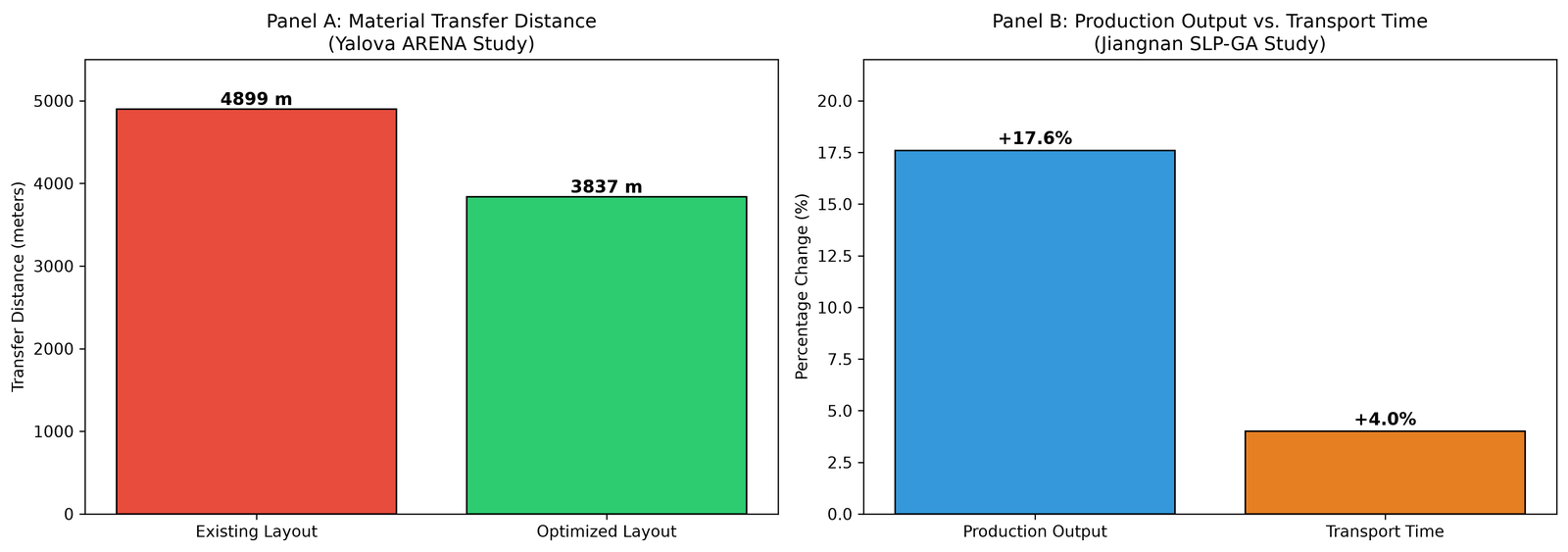
The value of DES is that it can compare multiple layouts under the same production conditions. A study conducted at a private shipyard in Yalova, Türkiye, used ARENA, a commercial DES software package, to model and compare two layouts of the same yard: the existing layout and an optimized alternative. The existing layout had a total material transfer distance of 4,899 meters. The optimized layout reduced this to 3,837 meters, a reduction of just over one thousand meters. That reduction in distance translated into a measurable reduction in time. In the existing layout, transfer time accounted for between 23.89 percent and 31.74 percent of total process time. In the optimized layout, that share fell to between 21.20 percent and 28.92 percent. Overall, layout optimization decreased transfer time by 12.17 to 15.71 percent and total process time by 2.55 to 4.42 percent.
These numbers are not dramatic in absolute terms, and that is an important point. Layout optimization does not transform a shipyard overnight. But a reduction of two to four percent in total process time, across hundreds of blocks and thousands of operations, adds up. It frees up crane capacity. It reduces the risk of delays cascading through the schedule. And it does so without requiring new equipment or additional labor. It is pure efficiency gain from better spatial arrangement.
3.3 Optimization Algorithms in Practice
Simulation evaluates a layout. Optimization searches for the best one. The problem is that the number of possible arrangements of workstations in a shipyard is astronomical. Even a modest yard with twenty departments has more possible layouts than can be evaluated by hand. This is where metaheuristic algorithms come in.
Genetic algorithms and simulated annealing are the two most commonly used optimization methods in shipyard layout research. A genetic algorithm mimics the process of natural selection. It starts with a population of candidate layouts, evaluates each one against a fitness function, and then combines the best performers to create a new generation of layouts. Over many generations, the population evolves toward better solutions. Simulated annealing takes a different approach. It starts with a single layout and makes small random changes, accepting improvements but also, early in the process, accepting some worse solutions to avoid getting stuck in local optima. The "temperature" of the process gradually decreases, and the algorithm becomes more selective, converging on a final solution.
A study from Universitas Indonesia compared the performance of these two algorithms on a shipyard facility layout problem with unequal area departments. Both algorithms started from the same initial solution. The genetic algorithm achieved an efficiency of 14.592 percent, while simulated annealing achieved 23.473 percent. That is a substantial difference, and it suggests that for this particular class of problem, simulated annealing's ability to escape local optima gives it an edge. But the result should not be overgeneralized. The performance of any metaheuristic depends on the specific problem, the constraints, and the way the algorithm is tuned. A genetic algorithm that performs poorly on one layout problem might perform well on another.
The more interesting development is the integration of SLP with optimization algorithms. SLP is good at generating layouts that respect qualitative relationships, but it does not systematically explore the space of possible arrangements. Optimization algorithms are good at searching that space, but they can waste time evaluating layouts that violate basic relationship requirements. When SLP is used to generate the initial population of layouts, and a genetic algorithm is then used to optimize within that population, the two methods compensate for each other's weaknesses.
A recent study from Shanghai Jiao Tong University and Jiangnan Shipyard used exactly this approach. The researchers used SLP to create logistics and non-logistics relationship matrices and generate initial layout strategies. They then used a genetic algorithm to perform global optimization, with constraints to prevent workstation overlap and to preserve transport pathways. The optimized layout achieved a 17.6 percent increase in production output while limiting the increase in material transportation time to just 4.0 percent. The fact that transport time increased at all is significant. A layout that increases production output will inevitably require more material movement. The goal is not to minimize transport time absolutely, but to minimize it relative to the increase in output. A 4.0 percent increase in transport time for a 17.6 percent increase in output is a favorable trade.
3.4 The Role of Material Handling Costs
One reason layout optimization matters so much is that material handling is expensive. In manufacturing generally, material handling costs account for somewhere between 20 and 50 percent of total operating costs. In shipbuilding, the figure can be higher, because the components being moved are enormous and the distances involved are long. A block that weighs hundreds of tons must be lifted by a crane capable of handling that weight, transported across the yard, and set down in the exact position where it will be joined to the rest of the hull. Every meter of unnecessary travel adds time, fuel, and risk.
This is why the objective function in most shipyard layout optimization studies is some form of material handling cost. The cost can be measured in time, in money, or in a combined metric that includes both. The specific units matter less than the principle: the layout that minimizes the total cost of moving material through the yard is, all else being equal, the better layout.
But all else is rarely equal. A layout that minimizes material handling cost might create safety hazards by placing incompatible activities too close together. It might reduce flexibility by locking the yard into a rigid flow pattern that cannot accommodate changes in product mix. And it might increase the cost of other factors, such as area utilization or building construction. This is why modern layout optimization studies increasingly treat the problem as multi-objective. The goal is not to find the single best layout by one metric, but to find a set of layouts that represent good trade-offs between competing objectives, leaving the final decision to the human designers who understand the yard's strategic priorities.
Chapter 4: What LEAN Actually Means in a Shipyard Context
LEAN is one of the most widely used and least understood terms in modern manufacturing. The word itself suggests simplicity: remove waste, improve flow, deliver value. The reality is more complicated. LEAN was born in a specific context, the Toyota Production System, where products were manufactured in high volumes with relatively stable designs and predictable demand. Shipbuilding shares almost none of these conditions. A shipyard building an offshore supply vessel or a naval frigate operates in a world of one-off orders, shifting designs, and production timelines measured in years rather than hours. The question, then, is not whether LEAN can be applied to shipbuilding. It is what LEAN must become when it is applied there.
4.1 The Seven Wastes in Shipbuilding Terms
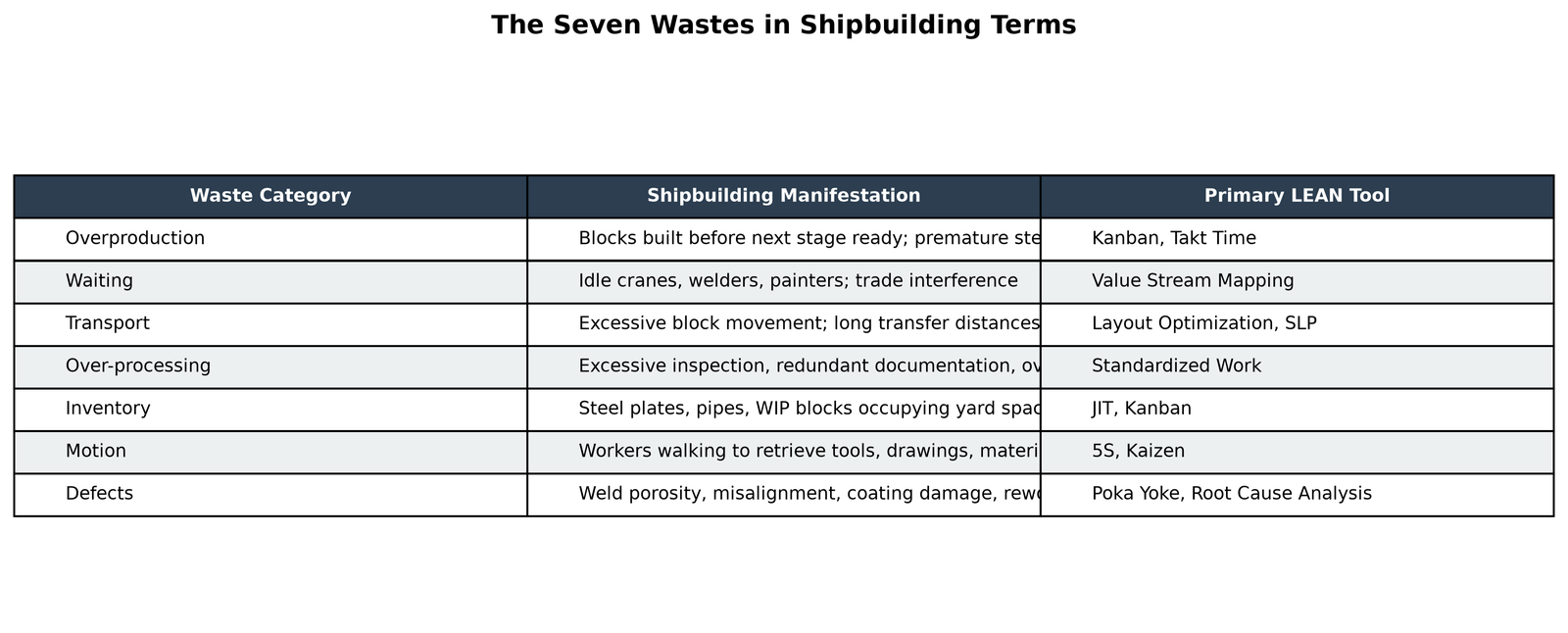
The foundation of LEAN thinking is the identification and elimination of waste. Taiichi Ohno, the architect of the Toyota Production System, defined waste as any activity that consumes resources without creating value for the customer. He identified seven categories of waste, and these categories have since become a standard framework for analyzing production systems. In a shipyard, each of the seven wastes takes on a specific and often severe form.
Overproduction is the waste of making more than the next process needs, sooner than it needs it. In shipbuilding, overproduction manifests most visibly in block construction. A fabrication shop may produce blocks at a rate that exceeds the capacity of the assembly hall or the building dock to absorb them. The result is a yard filled with finished blocks waiting for their turn to be erected. These blocks occupy valuable space, tie up capital in work-in-progress, and risk damage from weather, corrosion, and accidental impact. A related form of overproduction is the premature cutting of steel plates or the early assembly of components that cannot be installed until much later in the build sequence. The yard has paid for the labor and material, but the value cannot be realized until the downstream process is ready.
Waiting is the waste of time when people, equipment, or material are idle. In a shipyard, waiting is pervasive. Crane operators wait for blocks to be ready. Welders wait for plates to be positioned. Painters wait for surfaces to dry. Outfitting crews wait for the hull to be sufficiently complete to begin their work. A study of waste in shipbuilding found that waiting, defects, over-processing, transportation, and inventory were the dominant waste categories, with waiting consistently ranking among the most critical. The reason is structural. Shipbuilding involves a long sequence of dependent operations, and any delay in one stage cascades through the rest. A crane that is unavailable for four hours does not simply delay four hours of work. It disrupts the schedules of every trade that was counting on that crane.
Transport is the waste of moving material or products unnecessarily. In a shipyard, transport is everywhere. Steel plates arrive by truck or rail and are moved to storage. They are moved again to the cutting shop. Cut parts are moved to the panel line. Panels are moved to the block assembly area. Blocks are moved to the building dock. The ship itself is moved from the dock to the outfitting quay. Each of these movements adds time and cost without changing the form or function of the product. The Yalova case study described in the previous chapter found that transfer time accounted for between 23.89 percent and 31.74 percent of total process time in the existing layout, a figure that should shock anyone who assumes that shipbuilding is primarily about welding and assembly.
Over-processing is the waste of doing more work than the customer requires or than the next process needs. In shipbuilding, over-processing appears as excessive inspection, redundant documentation, and rework caused by unclear specifications. A weld that is ground and polished beyond what the classification society requires is over-processing. A pipe that is fabricated to tighter tolerances than the system needs is over-processing. A drawing that is revised three times because the design team cannot agree on a detail is over-processing. These activities consume labor and time but do not increase the value of the ship to the owner.
Inventory is the waste of holding more material than is needed for current production. In a shipyard, inventory takes the form of steel plates stacked in the yard, pipes stored in racks, valves and fittings in warehouses, and work-in-progress blocks waiting for the next stage. Inventory hides problems. If a yard has a large stock of steel plates, a delay in delivery from the steel mill will not be noticed immediately. The inventory cushions the yard from the consequences of poor planning, but it also ties up capital, occupies space, and increases the risk of damage and obsolescence. The lean solution is to reduce inventory to the minimum necessary and to rely on pull systems to replenish it only when consumption triggers a need.
Motion is the waste of unnecessary movement by people. A welder who must walk fifty meters to retrieve a tool or a drawing is wasting time. A supervisor who must cross the yard to check on a block is wasting time. A planner who must search through physical files to find a specification is wasting time. Motion waste is often overlooked because it is invisible in the accounting system, but it accumulates. A study at a shipyard found that motion was one of the critical waste categories, though it ranked below waiting and defects in terms of impact.
Defects are the waste of producing a product that does not meet requirements. In shipbuilding, defects include weld porosity, misaligned plates, incorrect dimensions, and damaged coatings. Defects are expensive not only because they require rework but also because they disrupt flow. A block with a defective weld cannot move to the next stage until the weld is repaired. If the repair requires the block to be moved back to a workshop, the entire schedule is affected. The same study found that defects were the most critical waste category, contributing 80 percent of the waste impact despite representing only 23.8 percent of the waste types identified.
4.2 Why Shipbuilding Is Different from Typical LEAN Environments
LEAN methods were developed for repetitive manufacturing. A car factory produces thousands of identical or nearly identical units. The takt time, the rate at which the customer demands finished products, is stable. The work content of each station is balanced. The supply chain delivers components at a predictable rate. Shipbuilding violates every one of these conditions.
The most fundamental difference is that shipbuilding is an engineer-to-order industry. Each ship is designed for a specific customer, with specific requirements, specific equipment, and specific layout. Even when a yard builds a series of similar vessels, there are variations. The second ship in a series is rarely identical to the first. This means that the work content of each ship is different, and the production process cannot be standardized to the same degree as in repetitive manufacturing. LEAN methods that depend on standardization and repetition, such as takt time and one-piece flow, are difficult to apply directly.
The cycle times in shipbuilding are also far longer than in typical manufacturing. A car can be assembled in a matter of hours. A ship takes months or years. This long cycle time means that problems that occur early in the process may not become visible until much later. A design error discovered during sea trials may have originated in the concept design phase, years earlier. LEAN's emphasis on short feedback loops and rapid problem-solving is difficult to sustain when the feedback loop spans months.
The production environment is also more complex. A shipyard involves multiple trades working in the same space, often simultaneously. Welders, pipefitters, electricians, painters, and outfitters must coordinate their work. The sequence of operations is not always linear. Piping may need to be installed before electrical cable trays, but electrical work may need to be completed before the space is closed up for painting. This interdependence creates scheduling problems that do not exist in a sequential assembly line.
The supply chain adds another layer of complexity. Shipbuilding relies on a global network of suppliers for engines, propellers, navigation systems, and countless other components. Lead times can be measured in months. A delay from a single supplier can disrupt the entire build schedule. LEAN's just-in-time approach, which works well when suppliers are nearby and reliable, becomes risky when the supply chain stretches across continents and the consequences of a stockout are severe.
A 2025 study on LEAN implementation in shipbuilding confirmed that the barriers associated with human factors and the intrinsic characteristics of shipbuilding were predominant obstacles. The intrinsic characteristics include the very high cycle times and the engineering-to-order production system. These are not problems that can be solved by applying LEAN more vigorously. They are structural features of the industry that require LEAN to be adapted rather than adopted wholesale.
4.3 The Most Effective LEAN Tools for Shipyards
Despite these challenges, LEAN tools have been applied successfully in shipyards around the world. The key is to select the tools that are most compatible with shipbuilding's characteristics and to modify them where necessary. A systematic review of LEAN practices in shipbuilding identified the most frequently implemented tools as Value Stream Mapping, Takt Time, Kaizen, Kanban, and Just in Time. Each of these tools requires adaptation, but each has demonstrated value in a shipyard context.
Value Stream Mapping is perhaps the most powerful LEAN tool for shipbuilding because it does not depend on repetitive production. A value stream map is a visual representation of the flow of material and information through a production process. It shows where value is added and where waste occurs. The map is created for a specific product or product family, and it can be drawn for a one-off ship just as easily as for a mass-produced car.
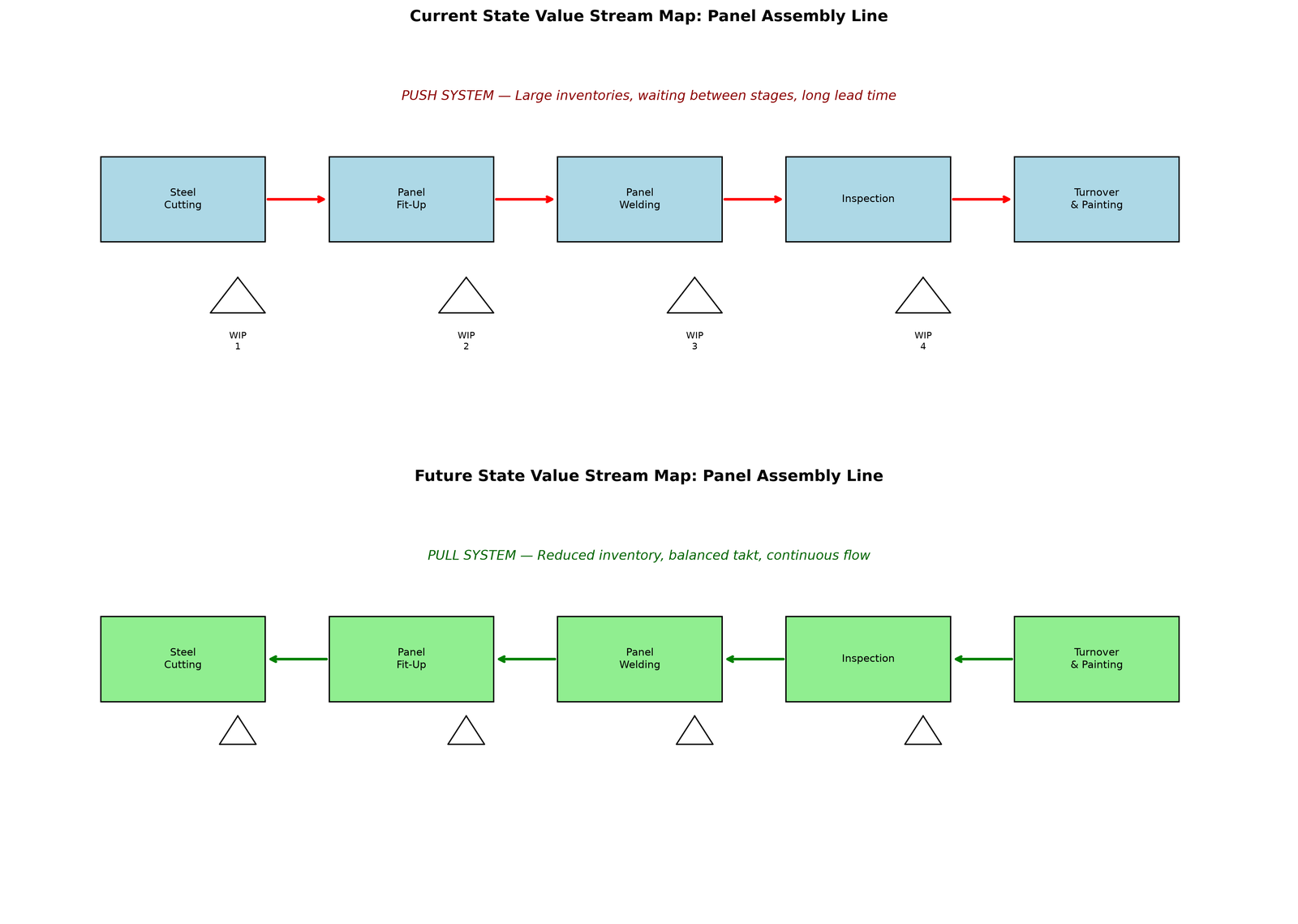
In shipbuilding, value stream mapping is typically applied to specific processes rather than the entire yard. The panel assembly line is a common focus because panels are the basic building blocks of well over 60 percent of the interim products of typical commercial ships. A value stream map of a panel assembly line shows the sequence of operations, the time required for each operation, the inventory between operations, and the information flows that control production. The map reveals where the flow is interrupted by waiting, where inventory accumulates, and where defects are introduced.
The application of value stream mapping to shipbuilding has produced impressive results. A study of a built-up panel assembly line in a newbuilding shipyard used value stream mapping along with kaizen principles to transform the production process, achieving man-hour reductions of about 60 percent. A separate study of panel assembly achieved man-hour reductions of over 80 percent, reducing the assembly time for a typical panel from 72 man-hours to 12. These are not marginal improvements. They represent a fundamental change in how the work is performed, achieved not by buying new equipment but by reorganizing the process to eliminate waste.
Takt time is the rhythm of production, calculated by dividing the available production time by the customer demand. In a car factory, takt time might be one minute per vehicle. In a shipyard, takt time is measured in days or weeks per block or per ship. The concept still applies, but the scale is different. Takt time provides a target for balancing work across stations and for pacing production so that material flows smoothly rather than in bursts.
The challenge in shipbuilding is that the work content varies from block to block and from ship to ship. A simple panel may require four hours of work at a station, while a complex block may require forty. This makes it difficult to establish a single takt time for the entire yard. The solution is to establish takt times for specific production lines or processes, such as the panel line or the block assembly line, where the work content is more consistent. A study of a shipyard block assembly workstation used takt times of four hours for panel forming and four hours for panel turnover, with a coefficient applied to account for the number of workers and the complexity of the work.
Kaizen, or continuous improvement, is a philosophy rather than a tool. It is the practice of engaging workers at all levels in identifying and eliminating waste. In shipbuilding, kaizen can be applied to small problems, such as the layout of a workstation, or to larger problems, such as the sequence of operations on a production line. The key is that improvement is continuous and incremental rather than episodic and radical.
Kaizen is particularly well suited to shipbuilding because it does not require a stable, repetitive process. Workers on a one-off ship can still identify waste in their own work and suggest improvements. The challenge is to create a culture where suggestions are welcomed and implemented. A study of LEAN implementation in shipbuilding found that human factors, including resistance to change and skill gaps, were among the most significant barriers. Kaizen addresses these barriers by giving workers ownership of the improvement process.
Kanban is a pull system for controlling production and inventory. In its simplest form, a kanban is a card that authorizes the production or movement of a specific quantity of material. When a downstream process consumes material, it sends a kanban card upstream to signal that more is needed. The upstream process produces only what the kanban authorizes, and no more.
Kanban is challenging to implement in shipbuilding because the production process is not a simple linear flow. A block may require components from multiple upstream processes, and the sequence of assembly may change from block to block. Nevertheless, kanban has been applied successfully in specific areas. Portsmouth Naval Shipyard implemented a kanban inventory system for submarine parts that significantly increased the availability and efficiency of the parts ordering and production process. The system uses a database to track parts in stock, and the Inside Machine Shop manufactures parts in batches to replenish the stock when it falls below a predetermined level. The result is that parts are available when they are needed, without the delays that occur when each part must be ordered individually.
Just in Time is the principle of producing or delivering material only when it is needed. In shipbuilding, JIT is difficult to implement on a large scale because of the long lead times for major components and the risk of disruption from suppliers. But JIT can be applied to smaller, locally sourced items. European yards have adopted just-in-time deliveries for materials ranging from steel plates to main propulsion machinery. The key is to have reliable suppliers and effective communication so that deliveries arrive at the moment they are needed rather than weeks or months in advance.
The common thread running through these tools is that they are not recipes to be followed rigidly. They are principles to be adapted. Value stream mapping works in shipbuilding because it can be applied to any process, repetitive or not. Takt time works when it is applied to specific production lines rather than the entire yard. Kaizen works when workers are empowered to make changes. Kanban works when it is applied to specific material flows. JIT works when suppliers are reliable and the consequences of a delay are manageable. The failure of LEAN in shipbuilding, when it fails, is usually a failure of adaptation rather than a failure of the principles themselves.
Chapter 5: LEAN in Practice: Case Evidence from Shipyards
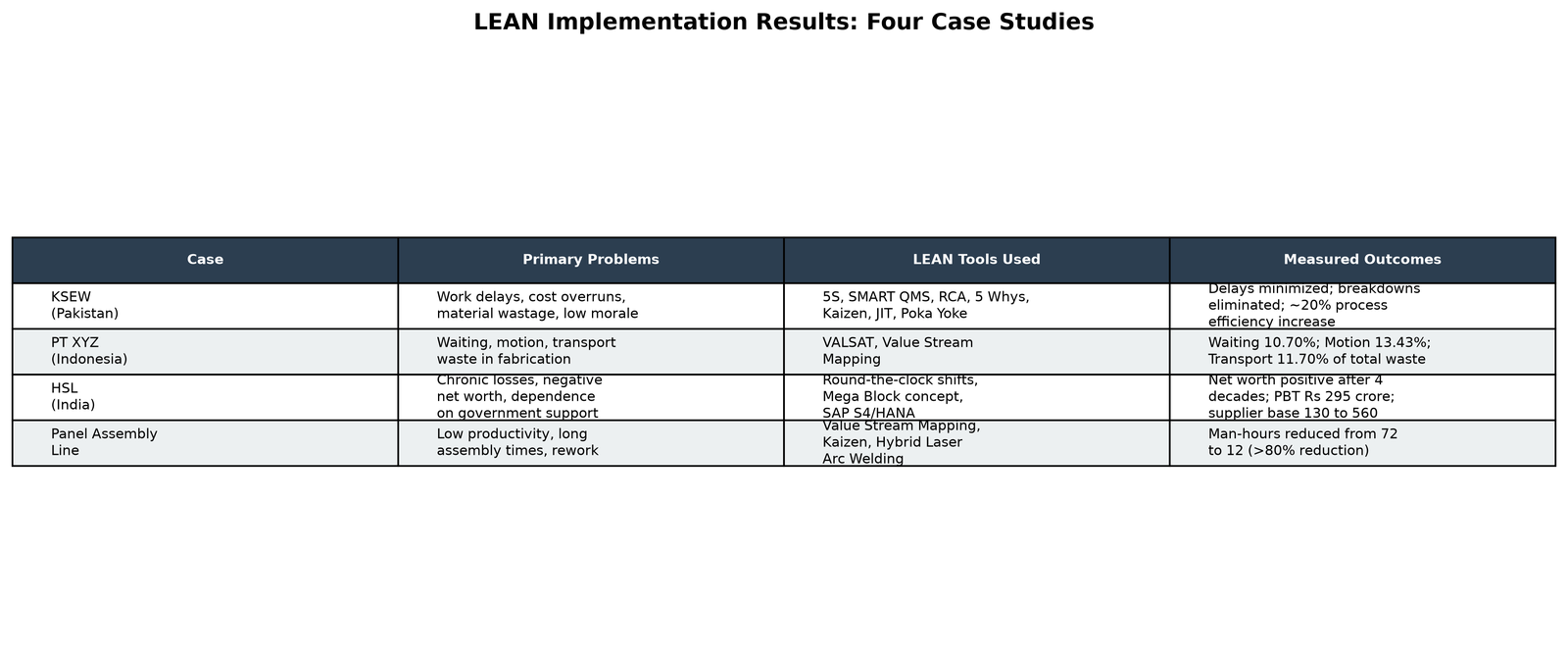
The previous chapter established what LEAN means in a shipbuilding context and why the tools must be adapted rather than copied. This chapter moves from principle to evidence. It examines documented cases of LEAN implementation in shipyards across different regions and scales, from a state-owned naval yard in Pakistan to a commercial shipbuilder in Indonesia, from a struggling Indian public sector enterprise to the panel assembly lines that form the backbone of medium-to-large shipyards everywhere. The purpose is not to present a catalogue of success stories. It is to understand what actually happens when LEAN meets the realities of shipbuilding: what improves, what resists, and what the numbers reveal about the limits and possibilities of the approach.
5.1 Karachi Shipyard & Engineering Works
Karachi Shipyard & Engineering Works, usually abbreviated as KSEW, is one of the oldest and most important shipbuilding facilities in Pakistan. For much of its history, it operated as a state-owned enterprise with a mandate to support naval and commercial shipbuilding. The problems it faced were not unusual for a public sector yard in a developing economy. Work delays were chronic. Costs overran budgets. Material wastage was high. Manpower utilization was low, and worker morale suffered under the weight of a system that seemed unable to deliver on its promises. These are the conditions that LEAN is supposed to address, but they are also the conditions that make LEAN implementation most difficult, because the organization has lost the habit of believing that improvement is possible.
The LEAN intervention at KSEW, documented in a 2025 conference paper, was not a single tool applied to a single problem. It was a package. The yard implemented 5S workplace organization, SMART quality management objectives, Root Cause Analysis, the 5 Whys method for problem investigation, Kaizen for continuous improvement, Just-in-Time for material flow, and Poka Yoke with Corrective and Preventive Action for error-proofing. The combination is significant. It suggests that KSEW's leadership understood that LEAN is not a tool but a system, and that the tools reinforce one another. 5S creates the order that makes root cause analysis possible. Root cause analysis identifies the problems that Kaizen then solves. Poka Yoke prevents those problems from recurring. Just-in-Time reduces the inventory that hides the underlying issues.
The reported results were substantial. Work order delays were minimized. Equipment breakdowns were eliminated. Workspace increased. Sorting time, rework, and material waste all declined. A subsequent study from the National University of Sciences and Technology in Pakistan examined the broader mechanization and lean manufacturing strategy at KSEW and found that the yard observed an increase in operational efficiency and a decrease in clutter as the production environment became leaner through 5S implementation. The study also reported that scaling up pilot projects across the shop floor during lean implementation brought about an overall increase of nearly 20 percent in process efficiency.
The KSEW case is instructive for two reasons. First, it shows that LEAN can produce measurable results in a shipyard that is not a greenfield site and does not have the advantages of a modern, well-funded European or East Asian facility. Second, it shows that the benefits are cumulative. No single tool produced the improvements. The gains came from the combination of workplace organization, quality management, and material flow discipline. The KSEW experience is a case study and benchmark model on implementing lean systems in the port and shipping industry, and its value lies precisely in the fact that it is not exceptional.
5.2 PT XYZ, Indonesia
The second case comes from Indonesia. PT XYZ is a shipyard engaged in new vessel construction, maintenance, repair, and engineering consultancy. Like many shipyards in the region, it faces pressure to improve productivity and reduce delays while operating in a competitive market where customers expect fixed prices and fixed delivery dates. The LEAN intervention at PT XYZ was part of a broader study examining both lean and green manufacturing in the ship production process, reflecting a growing recognition that waste reduction and environmental performance are connected.
The methodology at PT XYZ differed from the KSEW approach. Rather than implementing a package of tools across the yard, the researchers used Value Stream Analysis Tools, or VALSAT, to identify where waste was occurring and to prioritize improvement efforts. VALSAT is a structured method for selecting the most appropriate value stream mapping tool for a given problem. It avoids the mistake of applying the most familiar tool to every situation. The analysis at PT XYZ identified waiting times and inventory waste as the most significant problems in the fabrication workshops.
The quantitative results from the study are revealing. The waste assessment identified the percentage contribution of each waste category to the overall problem. Waiting waste accounted for 10.70 percent of the total waste. Motion waste contributed 13.43 percent, and transportation waste contributed 11.70 percent. Over-processing, at 4.31 percent, was the least significant category. These numbers are useful because they show where the problems actually are. In many shipyards, the assumption is that the biggest waste is in the fabrication process itself, in the cutting and welding of steel. The PT XYZ data suggests that a substantial share of the waste lies in the movement of people and materials and in the time spent waiting for the next operation to be ready. This is consistent with the layout studies discussed in Chapter 3, which found that transfer time accounted for a large fraction of total process time.
The PT XYZ study also demonstrated the connection between lean and green manufacturing. Reducing waiting time and inventory reduces energy consumption and material waste. A yard that produces blocks at the rate they are needed, rather than stockpiling them, uses less space, less heating and lighting, and less corrosion protection. The environmental benefits are a byproduct of the efficiency gains, not a separate initiative. This is an important insight for shipyards facing increasing regulatory pressure to reduce their carbon footprint.
5.3 Hindustan Shipyard Limited, India
The third case is different in scale and in the nature of the transformation. Hindustan Shipyard Limited, or HSL, is India's oldest shipyard, established in 1941 in Visakhapatnam. For decades, it was a symbol of the problems that plague state-owned enterprises: chronic losses, negative net worth, and dependence on government support. Even after its transfer to the Ministry of Defence in 2010, its financial position remained precarious. The turnaround that began around 2015 and culminated in the yard earning "Mini Ratna" status in 2025 is one of the most dramatic in the history of the industry.
The strategy that drove the turnaround was called the "Magic of Five." It covered five areas: operational efficiency, financial discipline, technology modernization, human resource development, and communication. This is not LEAN in the narrow sense of value stream mapping and kanban. It is a broader organizational transformation in which LEAN principles are embedded within a larger program of reform. The operational reforms included the adoption of round-the-clock production shifts and the implementation of the "Mega Block" concept, in which large sections of the ship are constructed individually with significant pre-launch outfitting and then assembled when complete. The Mega Block concept is essentially a lean idea applied at the shipyard level. It increases the amount of work done in a controlled environment, reduces the work done in the confined space of the dock, and improves the flow of the overall construction process.
The financial results were striking. In FY 2024–25, HSL posted a total income of approximately Rs 1,586 crore and a profit before tax of Rs 295 crore, turning net worth positive for the first time in about four decades. The yard expanded its supplier base from about 130 to more than 560 vendors, supporting local small and medium industries and reducing its dependence on a small number of suppliers. It implemented the SAP S4/HANA enterprise system for real-time tracking of construction progress and improved project costing and cash flow management.
The HSL case is important because it shows that LEAN in shipbuilding is not only about shop floor tools. It is about creating the organizational conditions in which those tools can work. The round-the-clock shifts increased the utilization of expensive capital equipment. The Mega Block concept changed the sequence of construction to reduce congestion and improve flow. The digital systems provided the visibility that managers need to make decisions. And the human resource development and communication components addressed the cultural barriers that often defeat technical improvement programs. HSL is now investing in robotic welding, AI-assisted inspection, and green shipbuilding as part of its modernization push. The LEAN transformation was not the end of the journey. It was the foundation on which further improvement could be built.
5.4 Panel Assembly Line Transformation
The final case moves from the level of the yard to the level of a specific production line. Panel assembly is the core competence of any medium-to-large shipyard. Ship panels are the basic building blocks of well over 60 percent of the interim products of typical commercial ships. If the panel assembly line is inefficient, the entire yard is inefficient, because every subsequent stage depends on the output of the panel line. Improving the panel assembly process therefore has a disproportionate effect on the yard's overall performance.
A study published in the Journal of Ship Production and Design in 2017 examined the application of lean methodology to a traditional panel assembly line in a commercial shipyard. The researchers used value stream mapping to create a current-state map of the panel assembly process, identifying the wastes, the takt time, and the areas where production was pushed rather than pulled. They then used lean tools and advanced technologies, including hybrid laser arc welding, to design a future-state panel assembly line.
The results were dramatic. The transformed panel assembly line achieved man-hour reductions of over 80 percent. A typical panel that previously required 72 man-hours to assemble was completed in 12 man-hours. A separate study of a built-up panel assembly line in a newbuilding shipyard reported man-hour reductions of about 60 percent, which the authors described as yielding remarkable cost savings. These are not incremental improvements. They represent a fundamental change in how the work is performed. And they were achieved not by adding workers or extending hours but by reorganizing the process to eliminate the waste that had been embedded in the traditional method.
The panel assembly case is the clearest demonstration in the literature that LEAN works in shipbuilding when it is applied to the right problem with the right tools. Panel assembly is more repetitive than many shipbuilding processes. The work content is more consistent from panel to panel. The flow of material is more linear. These conditions are closer to the repetitive manufacturing environment in which LEAN was born, and the results reflect that compatibility. The challenge for shipyards is to extend the same discipline to processes that are less repetitive and less predictable. The evidence suggests that this is possible, but it requires more adaptation and more patience.
Chapter 6: Barriers to LEAN Adoption in Shipbuilding
The previous chapter presented cases where LEAN has worked in shipyards. KSEW reduced delays and improved efficiency. PT XYZ identified where waste was concentrated. HSL turned around a failing enterprise. Panel assembly lines achieved man-hour reductions that would be remarkable in any industry. These are real results, documented in peer-reviewed studies and industry reports. But they are not the norm. For every yard that has successfully implemented LEAN, there are many more where the effort stalled, faded, or never began. Understanding why requires looking honestly at the obstacles.
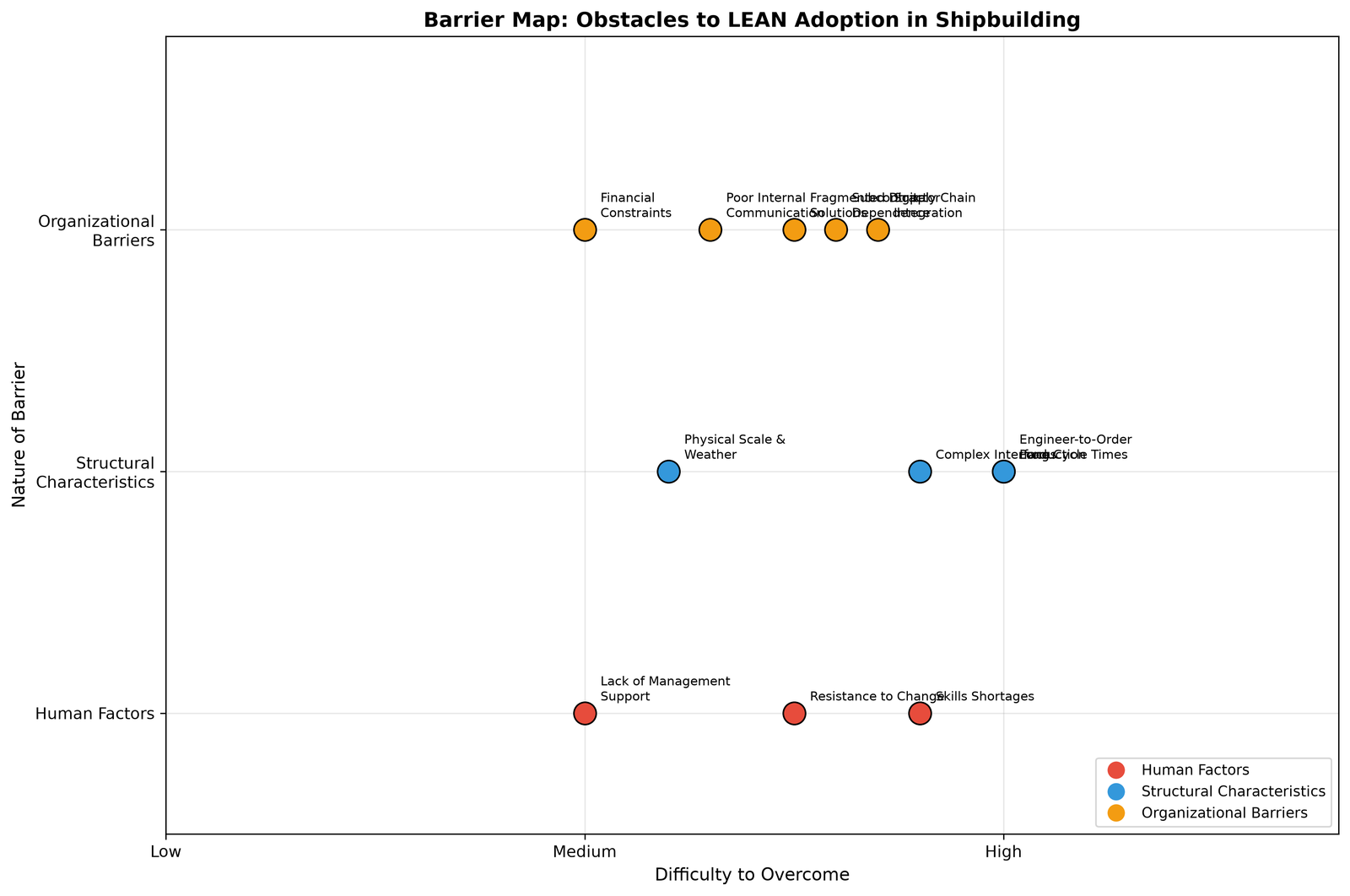
A systematic literature review published in the Journal of Marine Science and Technology in 2025 examined lean practices across the shipbuilding industry and concluded that the barriers associated with human factors and the intrinsic characteristics of shipbuilding were predominant as obstacles to implementing lean. That finding is important because it identifies two distinct categories of difficulty. Human factors are about people: their attitudes, skills, and willingness to change. Intrinsic characteristics are about the nature of shipbuilding itself: its long cycle times, its engineer-to-order production model, its complexity. The first category can be addressed through training, leadership, and culture change. The second cannot be changed. It must be accommodated.
6.1 Human Factors: Resistance, Skills, and Culture
Resistance to change is the most frequently cited barrier to LEAN adoption in shipbuilding. It is also the most misunderstood. When managers say that workers are resistant to change, they often mean that workers are unwilling to do what they are told. The research tells a more nuanced story. A study of a Malaysian shipyard found that resistance to change was attributed to a dysfunctional organizational context, specifically technical and political or structural issues that gave rise to non-conformance behavior. The resistance was not simply stubbornness. It was a response to an environment in which workers did not believe that the standards being imposed on them were coherent or achievable. The researchers found that resistance was due to "incoherency of a person's belief to establish standards, giving rise to cognitive dissonance". In plain terms, workers resist when they are asked to follow rules they do not understand or trust.
This insight has practical implications for LEAN implementation. If workers are told to adopt 5S or kanban without understanding why, they will comply superficially at best. The tools will be applied as rituals rather than as solutions to real problems. The same Malaysian study found that lean principles could reduce resistance by creating "psychological flow in the workforce and the momentum for change". The key was not to impose LEAN from above but to engage workers in the process of identifying and solving problems. When workers see that LEAN tools make their jobs easier, safer, or more satisfying, resistance diminishes.
The shortage of qualified specialists is a related problem. A study on digital transformation in shipbuilding identified "personnel resistance to change, a shortage of qualified specialists, and fragmentation of digital solutions" as key barriers. The fragmentation point is particularly relevant to LEAN. Many shipyards have planners who understand production scheduling, engineers who understand design, and foremen who understand the shop floor, but few people who can bridge these domains. LEAN implementation requires exactly this kind of bridging. Someone has to translate the principles of value stream mapping into the language of a shipyard, and that requires both technical knowledge and organizational credibility.
Lack of management support is another persistent barrier. A systematic review of Lean and Six Sigma in the maritime sector found that "the success of LSS implementation is highly influenced by management support, human resource readiness, and the availability of reliable data, with the main obstacles being cultural resistance, limited initial investment, and lack of technical training". Management support is not just about approving a budget. It is about sustained attention. LEAN transformations take years, not months. A yard that launches a LEAN program with great fanfare and then moves on to the next initiative will fail. The workers will notice, and the next initiative will be met with even more skepticism.
Cultural resistance is often described as a general reluctance to change, but it has specific roots in shipbuilding. Shipyards have long-established hierarchies. Trades have their own identities and rivalries. The relationship between management and labor is often adversarial, shaped by decades of contract negotiations and disputes. LEAN requires cooperation across these boundaries. It asks welders, pipefitters, electricians, and painters to coordinate their work in ways that may not respect traditional trade boundaries. It asks management to listen to workers and to take their suggestions seriously. These are not small changes in organizational culture. They are fundamental shifts in how authority and expertise are distributed.
6.2 The Intrinsic Characteristics of Shipbuilding
The second category of barriers is structural. These are features of shipbuilding that cannot be changed by training or leadership. They must be designed around.
The most fundamental is the engineer-to-order production model. A shipyard does not build the same ship over and over. It builds a ship that has been designed for a specific customer, with specific requirements, and then it builds a different ship for a different customer. The production process must accommodate this variety. The work content of each ship is different. The sequence of operations may change. The supply chain for each ship involves different suppliers and different lead times. A 2025 study of Industry 4.0 technologies in engineer-to-order companies, including shipbuilding, described the context as "high-mix low volumes and non-repetitive production settings" and noted that "Lean methods are often difficult to apply in non-repetitive environments".
The long cycle time of shipbuilding is another structural barrier. A ship may take one to three years to build. During that time, the design may change, the customer's requirements may evolve, and the supply chain may encounter disruptions. LEAN's emphasis on short feedback loops and rapid problem-solving is difficult to sustain when the feedback loop spans months. A defect discovered during sea trials may have been introduced during steel cutting, two years earlier. By the time the problem is identified, the people who made the decision may have moved to another project. The organizational memory that supports continuous improvement is weaker when the cycle time is long.
The complexity of shipbuilding also creates barriers. A ship is not a single product. It is a collection of systems: structural, mechanical, electrical, plumbing, HVAC, and countless others. These systems must be integrated, and their integration creates interfaces that are sources of delay and rework. A pipe that must be routed around a structural member may require a design change. A cable tray that conflicts with an HVAC duct may require one system to be redesigned. These interface problems are difficult to predict and difficult to resolve within a LEAN framework because they are not repetitive. Each interface problem is unique.
The physical scale of the product adds another layer of difficulty. Shipbuilding takes place in large, open yards where weather, crane availability, and spatial constraints affect production. Unlike a factory, where the environment is controlled and the flow of material is predictable, a shipyard is exposed to the elements and subject to the limitations of heavy lifting equipment. A crane that is needed for a critical lift may be unavailable because it is being used for another lift that was delayed by rain. The variability created by these factors makes it difficult to establish stable takt times and reliable pull systems.
6.3 Organizational and Supply Chain Barriers
Beyond human factors and intrinsic characteristics, there are organizational barriers that shape how LEAN is implemented, or whether it is implemented at all.
Fragmentation of digital solutions is a significant obstacle. Many shipyards have invested in software for design, planning, procurement, and production, but these systems often do not communicate with one another. A design change made in the CAD system may not automatically update the production schedule. A delay in the supply chain may not be visible to the shop floor until it is too late. LEAN depends on the flow of accurate information. When information is fragmented across incompatible systems, the flow breaks down. A study on barriers to digital transformation in shipbuilding identified "fragmentation of digital solutions" as a key barrier, alongside personnel resistance and skills shortages.
Supply chain integration is another challenge. LEAN's just-in-time principle requires suppliers to deliver materials at the moment they are needed. In shipbuilding, this is difficult because the supply chain is global and the lead times are long. Shipbuilders seem reluctant to implement the tight integration of supply chains that is necessary for just-in-time to work, partly because of concerns about confidentiality and partly because of the risk of disruption. A delay from a single supplier of engines or navigation systems can halt production in the building dock. The consequences of a stockout are severe enough that many yards prefer to hold buffer inventory rather than rely on just-in-time delivery.
Internal communication is often poor. A study of outbound logistics in shipbuilding found that "material flow was non-standardized, often following individual practices rather than common procedures. The required pull method for JIT deliveries was not implemented, and the process' visibility was limited due to the inconsistent reporting and information sharing". This is a description of a yard where LEAN principles have not taken root, where each department or individual does what seems best in the moment rather than following a coordinated plan. The absence of standardized procedures is both a symptom of failed LEAN implementation and a barrier to future implementation. It is difficult to improve a process that is not defined.
Financial constraints are a practical barrier. LEAN implementation requires investment: in training, in consulting, in software, and in the time that workers spend on improvement activities rather than on production. A study of barriers to lean implementation identified "a lack of financial resources, such as a lack of funds for training, outside advisors or any associated investment needed for Lean adoption" as a significant obstacle. For shipyards operating on thin margins, or for state-owned yards dependent on government funding, this investment may be difficult to justify, especially when the returns are uncertain and the payback period is long.
The dependence on subcontractors adds another layer of complexity. Shipyards often rely on subcontractors for specialized work: painting, insulation, electrical installation, and outfitting. These subcontractors may have their own work practices, their own schedules, and their own cultures. Integrating them into a LEAN system is difficult because the yard does not control their employment conditions or their training. A lean transformation that works for the yard's own employees may fail when applied to subcontractors who are not part of the same organizational culture.
6.4 The Potential of Industry 4.0 to Mitigate Barriers
The barriers described above are formidable, but they are not insurmountable. A growing body of research suggests that Industry 4.0 technologies can mitigate some of the barriers to LEAN implementation, particularly in engineer-to-order contexts like shipbuilding.
A 2025 study by Schulze et al. examined the mitigation effect of Industry 4.0 technologies on Lean implementation barriers in ETO companies, including shipbuilding. The researchers interviewed seventeen companies from the construction, customized machinery, and shipbuilding sectors across Europe. Their framework proposed that technologies such as real-time data collection, digital twins, and automated tracking could address specific barriers. For example, the difficulty of adapting Lean from repetitive to non-repetitive production settings could be mitigated by digital tools that provide visibility into unique production processes. The lack of process reliability could be addressed by sensors and monitoring systems that detect deviations in real time.
The same logic applies to other barriers. Resistance to change can be reduced when workers see that digital tools make their jobs easier. Skills shortages can be addressed through training programs that use simulation and augmented reality. Fragmentation of digital solutions can be reduced by integrating systems through a common data platform. The key insight is that Industry 4.0 and LEAN are complementary rather than competing. Digital technologies provide the data and visibility that LEAN needs to function in a complex, non-repetitive environment.
This convergence is sometimes called Lean 4.0. A study on lean manufacturing in shipbuilding and ship repair proposed the development of "Lean 4.0 industry standards and the creation of hybrid implementation models suitable for enterprises of different scales". The idea is to combine the process discipline of LEAN with the analytical power of digital tools. A value stream map created manually can be updated continuously with real-time data. A takt time calculated from historical averages can be adjusted dynamically as conditions change. A kanban system based on physical cards can be replaced by an electronic pull system that responds to actual consumption.
But Lean 4.0 is not a solution in itself. The same human factors that impede LEAN implementation will impede digital transformation. A study on key barriers to digital transformation in shipbuilding identified personnel resistance, skills shortages, and fragmentation as the principal obstacles. These are the same barriers that slow LEAN adoption. The technologies are new, but the organizational challenges are familiar.
6.5 What the Barriers Mean for Practice
The barrier analysis in this chapter is not an argument against LEAN in shipbuilding. The case evidence in Chapter 5 shows that LEAN can work. But the barriers explain why it often does not, and they suggest what a realistic implementation strategy must look like.
First, LEAN implementation in shipbuilding must be patient. The structural characteristics of the industry, long cycle times, one-off production, complex interfaces, mean that improvements take time to show results. A program that is expected to deliver measurable gains within a year will be judged a failure, even if it is laying the groundwork for long-term improvement. Yards that have succeeded with LEAN, such as HSL with its "Magic of Five" strategy, treated it as a multi-year transformation rather than a quick fix.
Second, LEAN must be adapted to the shipbuilding context. The tools that work in a repetitive manufacturing environment, such as takt time and one-piece flow, must be modified for the realities of a shipyard. Value stream mapping works because it can be applied to any process, repetitive or not. 5S works because it addresses universal problems of workplace organization. Kaizen works because it engages workers in solving the problems they face every day. The tools that depend on stability and repetition are less effective. The successful cases in the literature are those where the tools were adapted to the problem, not imposed according to a textbook formula.
Third, the human dimension cannot be ignored. Resistance to change is not a technical problem with a technical solution. It is a problem of trust, understanding, and engagement. Workers who are asked to adopt new practices must understand why those practices matter. They must believe that their input is valued. They must see that the changes make their work better, not just more efficient for the company. The Malaysian shipyard study found that LEAN principles reduced resistance by creating psychological flow. That is a cultural outcome, not a technical one.
Fourth, the barriers are interconnected. Human factors, structural characteristics, organizational issues, and supply chain challenges do not exist in isolation. A skills shortage makes it harder to address process reliability. A fragmented digital system makes it harder to identify and solve problems. A culture of resistance makes it harder to implement new tools. LEAN implementation must address these barriers as a system, not as a checklist of individual problems. The yards that have succeeded have done so by taking a holistic approach, combining process improvement with cultural change and organizational reform.
Chapter 7: The Digital Layer: Industry 4.0 and LEAN Integration
The barriers described in the previous chapter are real, but they are not static. The tools available to shipyards are changing, and some of those changes directly address the obstacles that have historically made LEAN difficult to implement in shipbuilding. Digital technologies, collectively referred to as Industry 4.0, offer new ways to collect data, visualize processes, and coordinate production. When these technologies are combined with LEAN principles, the result is something that researchers have begun to call Lean 4.0. The question is whether this combination lives up to its promise or whether it simply adds a new layer of complexity to an already difficult industry.
7.1 Digital Twins for Shipyard Scheduling and Block Management
A digital twin is a virtual replica of a physical system that is updated with real-time data from the physical system. In a shipyard, a digital twin can represent the entire yard, a specific production line, or a single block as it moves through the construction process. The value of the digital twin lies in its ability to simulate what-if scenarios without disrupting actual production. A planner can ask what would happen if a crane broke down, or if a block arrived late, or if the sequence of operations were changed. The digital twin provides an answer in minutes rather than days.
The application of digital twins to shipyard block management has received significant attention in recent research. A 2025 study from Shanghai Jiao Tong University developed a digital twin-driven scheduling strategy for ship block yard operations. The problem the researchers addressed is familiar to anyone who has worked in a yard: low spatiotemporal utilization and significant scheduling delays. Blocks sit in the yard waiting for their turn to be erected, occupying space that could be used for other blocks, while the building dock waits for blocks that are not ready. The digital twin approach uses a bi-objective mixed-integer programming model that integrates yard layout constraints and production process constraints, combined with an enhanced priority rule and a genetic algorithm incorporating the Dimensionally Extended 9-Intersection Model. The results, validated against real-world shipyard data, demonstrated significant improvements in spatiotemporal utilization, reduced delayed blocks, and decreased overall scheduling time.
The technical details matter less than the principle. The digital twin gives planners a tool to see the consequences of their decisions before those decisions are made. In a traditional yard, scheduling is often done on spreadsheets and whiteboards, with updates made by hand and communicated by phone or radio. By the time the information reaches the people who need it, it is already out of date. The digital twin closes that gap. It provides a shared, real-time view of the yard that everyone can see and trust.
A related application is the use of digital twins for transporter scheduling. A study published in PLOS ONE in 2024 addressed the problem of scheduling multiple transporters in a shipyard, considering factors such as block size and transporter loading capacity. The researchers established a framework of digital twin-based multiple transporters in a virtual environment. By inputting block information into the system, a solution is generated using transporter scheduling rules and interference detection methods. The experimental results showed that the approach effectively enhances transportation efficiency and improves ship construction efficiency. This is a concrete example of how digital tools can address one of the most persistent wastes identified in Chapter 4: the time and cost of moving material through the yard.
7.2 AI-Powered Production Planning and Real-Time Monitoring
Artificial intelligence is beginning to change how shipyards plan and monitor production. The most visible development is the partnership between HD Korea Shipbuilding & Offshore Engineering and Siemens Digital Industries Software, announced in July 2026. The two companies signed an agreement to adopt an AI platform for shipbuilding that is designed to build an autonomous manufacturing system digitally connecting the entire shipbuilding process, from vessel design and production to supply chain management and maintenance. Through the platform, shipyards will be able to transmit design changes and real-time production updates directly to the shop floor and across the supply chain, enabling faster, more informed decision-making to help prevent schedule delays and quality issues.
The significance of this partnership goes beyond the specific technology. HD KSOE is the intermediate holding company of HD Hyundai, which includes HD Hyundai Heavy Industries and Hyundai Samho Heavy Industries, two of the largest shipyards in the world. When a company of this scale invests in AI-powered production planning, it signals that the technology has moved from the research laboratory to the shop floor. The company aims to establish a fully autonomous shipyard by 2030, deploying digitalization, AI, and robotics across critical operations including real-time operational monitoring, communication, automation, and safety management.
AI is also being applied at a more granular level. In Chinese shipyards, AI scheduling technology has compressed production planning tasks that previously took more than ten days into half an hour. This is not a marginal improvement. It is a fundamental change in the speed at which decisions can be made and revised. A planner who can generate a new schedule in thirty minutes can respond to disruptions in near real time, rather than waiting days for a revised plan to work its way through the organization.
The combination of AI and real-time data collection also opens new possibilities for quality control. Intelligent welding systems now in use at Ingalls Shipbuilding automatically recognize workpieces and welding conditions, correct welding positions in real time, and capture process data that can support quality control and traceability. A single operator can manage multiple welding robots simultaneously, while production data is collected and stored in real time for quality control and process optimization. This is LEAN's poka-yoke principle in digital form. Instead of relying on a physical fixture to prevent errors, the system uses sensors and algorithms to detect and correct deviations as they occur.
7.3 The Lean 4.0 Concept
The integration of LEAN principles with Industry 4.0 technologies has given rise to a concept that researchers call Lean 4.0. The term is not simply a marketing label. It describes a genuine synthesis in which digital tools amplify the effectiveness of lean methods and lean thinking provides the process discipline that digital tools require to deliver value.
A 2026 study published in a Russian shipbuilding journal developed a comprehensive methodology for implementing lean manufacturing in shipbuilding and ship repair with the integration of Industry 4.0 digital technologies and the Analytical Hierarchy Process. The study analyzed current trends in the digital transformation of lean manufacturing, including the application of BIM technologies for value stream mapping, IoT sensors for predictive analytics, and cloud platforms for automating Andon systems. Each of these applications represents a direct enhancement of a traditional lean tool. Value stream mapping, which is normally a manual process updated periodically, becomes a living document when BIM data feeds into it continuously. Andon cords, which workers pull to signal problems, become automated when IoT sensors detect deviations and alert supervisors before the worker even notices.
The results reported from practical testing of the proposed methodology are substantial: a 40 to 60 percent reduction in management decision-making time and a 35 percent decrease in the number of erroneous decisions. The study also reports a 15 to 20 percent reduction in construction time, a 10 to 15 percent reduction in production costs, and a 25 to 30 percent increase in the transparency of management decisions. These figures should be treated with caution, as they come from a single study and the specific context of implementation matters enormously. But they point in a consistent direction. The combination of lean process discipline with digital decision support produces better outcomes than either approach alone.
The study also identified the same barriers that were discussed in Chapter 6: personnel resistance to change, a shortage of qualified specialists, and fragmentation of digital solutions. The proposed mechanisms for overcoming these barriers include the development of Lean 4.0 industry standards and the creation of hybrid implementation models suitable for enterprises of different scales. The emphasis on hybrid models is important. Not every shipyard can afford or should attempt a full-scale digital transformation. A small or medium-sized yard may benefit from a targeted application of digital tools to a specific bottleneck, combined with a disciplined lean approach to process improvement. The Lean 4.0 concept is not a one-size-fits-all prescription. It is a framework for selecting the right combination of tools for a given context.
7.4 Robotics and Automation in the Production Flow
The most tangible manifestation of Industry 4.0 in shipbuilding is the increasing use of robotics and automation in production processes. Robotic welding is the most mature application. The technology has advanced to the point where robotic welding machines can produce joints and beads that compete with some of the most highly skilled human welders, creating smoother connections more effectively and with less wasted metal.
The Ingalls Shipbuilding pilot program, conducted in partnership with HD Hyundai Heavy Industries, represents one of the most significant deployments of intelligent mechanized welding in a U.S. shipyard. The systems are deployed in unit-fabrication areas that currently rely predominantly on manual welding. They are designed to make welding safer and more efficient, automatically recognizing workpieces and welding conditions and correcting welding positions in real time. Ingalls has ensured the machines comply with existing U.S. Navy fabrication standards and will use the pilot to identify opportunities for further automation.
The European Mari4_YARD project took a different approach. Rather than deploying large, fixed robotic systems, the project developed portable collaborative robots for welding and cutting applications in shipbuilding. The portability of the solution and its automatic detection and execution of cuts within structures were demonstrated, with real-time data integration into the digital thread achieving vertical integration. The project also developed augmented reality and mixed reality solutions using tablet devices, headsets, and projectors to assist workers in marking and cutting tasks during outfitting, allowing faster and more accurate performance while reducing mistakes and the use of printed materials.
The significance of these developments for LEAN is that they address several of the seven wastes simultaneously. Robotic welding reduces defects by producing consistent, high-quality joints. It reduces motion waste by eliminating the need for welders to physically move along the workpiece. It reduces waiting by operating continuously without the fatigue and breaks that affect human workers. And it reduces over-processing by applying precisely the amount of weld material required, no more and no less. The digital data captured by these systems also feeds into the continuous improvement process, providing the objective measurements that kaizen requires.
7.5 The Virtual Shipyard
A concept that ties together many of these developments is the virtual shipyard. This is not simply a digital twin of a single production line or a scheduling tool for block management. It is a comprehensive digital representation of the entire yard that can be used for planning, training, and operational decision-making.
HD KSOE's plan to create a Virtual Shipyard that mirrors actual shipyard operations is one of the most ambitious examples. The virtual shipyard would allow planners to test production scenarios, train workers in a safe environment, and optimize the layout and flow of the yard before any physical changes are made. The Necoverse project, developed for the Meyer shipyard, takes a similar approach. It aims to develop new training, planning, and operating environments in shipbuilding using an interactive virtual world. The project brings new opportunities for collaboration, allowing engineers, planners, and workers to interact with the same virtual model.
The value of the virtual shipyard for LEAN implementation is that it provides a risk-free environment for experimentation. One of the barriers to lean adoption identified in Chapter 6 is the fear of disruption. Workers and managers are reluctant to change established processes because they worry that the change will make things worse. A virtual shipyard allows changes to be tested before they are implemented in the physical yard. If the change works in the simulation, it can be deployed with greater confidence. If it does not, nothing is lost. This reduces the perceived risk of improvement and makes it easier to build support for change.
The Virtual Shipyard Training Program delivered by Dassault Systèmes in South Australia illustrates another application. The program provides a learning pathway to digital fluency that can be embedded within a business operation, covering industry-specific processes against twelve key digital competencies including supply chain and cost management, production planning and scheduling, and quality management. This is not simply about teaching workers to use software. It is about developing the digital literacy that LEAN 4.0 requires. A workforce that understands how data flows through the yard and how digital tools can be used to improve processes is a workforce that can participate meaningfully in continuous improvement.
7.6 The Limits of the Digital Layer
The digital layer is powerful, but it is not a substitute for the fundamentals. A shipyard that has not mastered 5S will not benefit from a digital twin. A yard that has not established basic process discipline will not benefit from AI-powered scheduling. The digital tools amplify what is already there. If what is there is disorder and waste, the tools will amplify that too.
The barriers discussed in Chapter 6 do not disappear when digital tools are introduced. Personnel resistance to change remains. Skills shortages remain. Fragmentation of digital solutions can actually worsen when new tools are added without a plan for integration. A study on barriers to digital transformation in shipbuilding identified personnel resistance, a shortage of qualified specialists, and fragmentation of digital solutions as key obstacles, the same barriers that impede LEAN implementation. The technologies are new. The organizational challenges are familiar.
This is why Lean 4.0 is best understood not as a replacement for traditional LEAN but as an extension of it. The core principles remain: identify value, map the value stream, create flow, establish pull, and pursue perfection. The digital tools provide new ways to execute those principles, especially in the complex, non-repetitive environment of a shipyard. They do not change the principles themselves. They make them more powerful, but only when the organization is ready to use them.
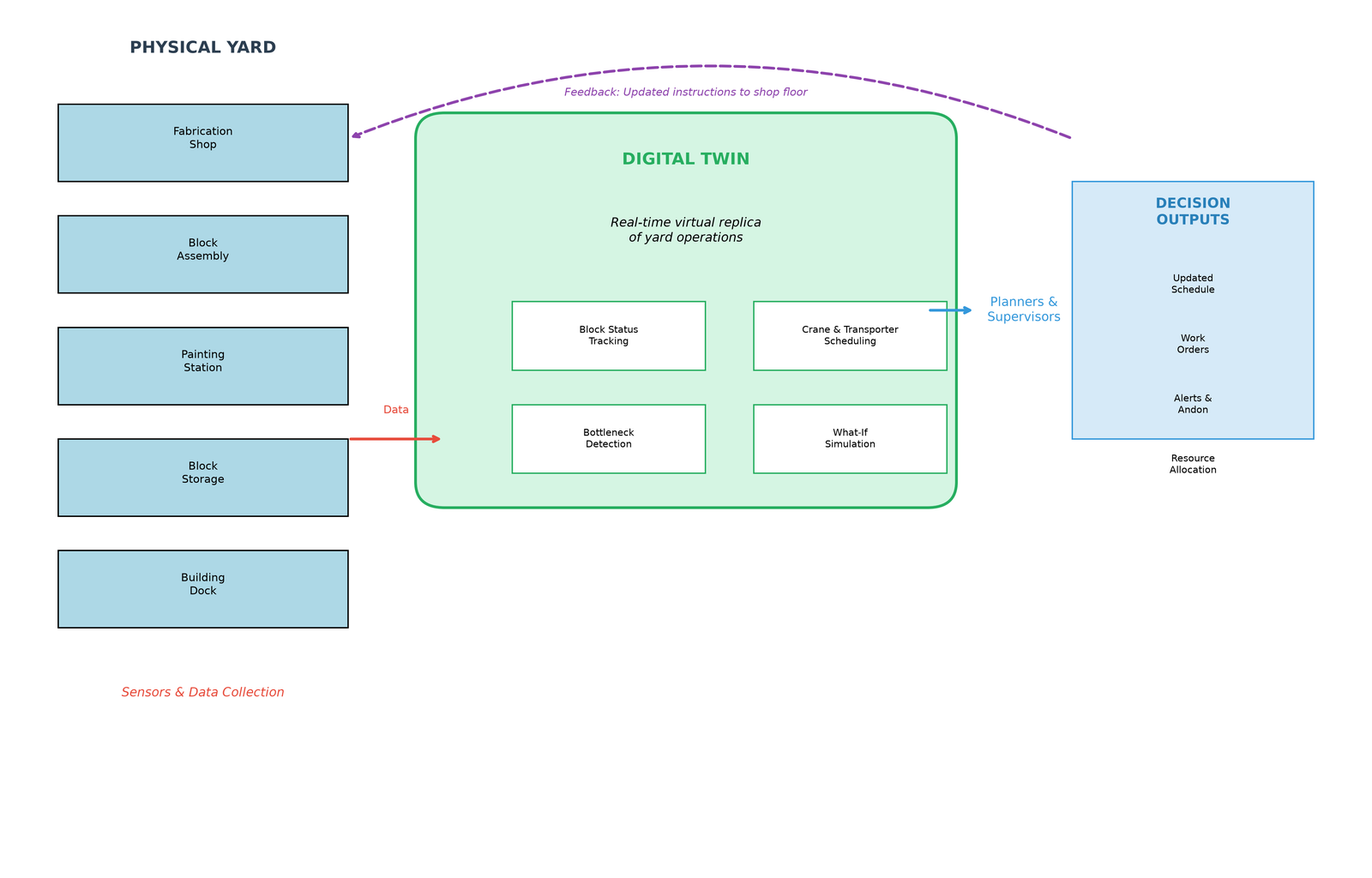
Chapter 8: Synthesis and Forward Look
The evidence gathered across these chapters points to a conclusion that is neither as optimistic as the LEAN literature sometimes suggests nor as pessimistic as the barriers would imply. Shipyard design and LEAN implementation both deliver measurable results. Neither is a quick fix. The yards that have succeeded are those that treated efficiency as a long-term engineering and organizational problem rather than a program to be launched and declared complete.
The design evidence is the more straightforward of the two. Layout determines the baseline cost of moving material, and material movement is a substantial share of total production time in most yards. The Yalova study found transfer time consuming between roughly a quarter and a third of total process time. The Jiangnan study showed that a layout optimized through combined SLP and genetic algorithm methods could raise production output by 17.6 percent while adding only 4.0 percent to transport time. These are real gains, achieved through spatial reasoning rather than capital investment. A yard can spend millions on new cranes and still lose more time to a poorly arranged workstation than it gains from the equipment. The reverse is also true. A yard with modest equipment and a well-designed flow can outperform a better-equipped competitor.
The LEAN evidence is messier, and that messiness is itself the finding. Panel assembly lines have achieved man-hour reductions of sixty to eighty percent, which is remarkable. Those results came from processes that are relatively repetitive and whose work content is relatively consistent. The gains at KSEW, PT XYZ, and HSL were real but more incremental, and they came bundled with organizational reform rather than from LEAN tools alone. HSL's turnaround was not a value stream mapping exercise. It was a decade-long program that included round-the-clock shifts, a restructured supplier base, enterprise software, and a reorganized construction sequence. LEAN principles were present, but they were embedded in a broader transformation.
This is the recurring theme. LEAN in shipbuilding works when it is translated rather than transplanted. The tools that depend on stability and repetition, such as strict takt time and one-piece flow, must be modified for an industry that builds one-off products on cycles measured in years. The tools that depend on observation and engagement, such as value stream mapping, 5S, and kaizen, transfer more readily because they do not require repetitive production. They require only that someone looks carefully at the work and asks why it is done this way.
The unresolved problem is measurement. Almost every case in the literature reports improvement, but the metrics are not comparable. One study reports transfer time as a percentage of process time. Another reports man-hour reductions. Another reports process efficiency increases. Another reports profit before tax. Without a common framework for measuring shipyard LEAN performance, it is difficult to know which interventions are genuinely effective and which merely appear effective within their own reporting context. The proposal for Lean 4.0 industry standards, raised in the Russian study discussed in Chapter 7, addresses this gap directly. Standardized metrics would allow yards to benchmark against each other and would give researchers a basis for comparing results across cases. Until such standards exist, the evidence for LEAN in shipbuilding will remain suggestive rather than conclusive.
The most promising direction is the convergence of LEAN and digitalization. The barriers that have historically limited LEAN adoption, particularly the difficulty of managing complex, non-repetitive production and the fragmentation of information across departments, are precisely the problems that digital tools are designed to address. A digital twin can track the status of every block in the yard. An AI scheduling system can generate a revised plan in half an hour. Sensors can detect process deviations before they become defects. These capabilities do not replace the discipline of LEAN. They extend its reach into areas where manual methods cannot keep up.
But the digital layer inherits the same organizational vulnerabilities. Personnel resistance, skills shortages, and fragmented systems impede digital transformation just as they impede LEAN implementation. A yard that cannot sustain a 5S program will not sustain a digital twin. The technology is not the hard part. The hard part is building an organization that can absorb change, learn from its own data, and keep improving after the initial enthusiasm fades.
One final observation deserves emphasis. Shipbuilding is a project business. Each ship is a distinct undertaking with its own schedule, budget, and set of technical challenges. Efficiency strategies that treat the yard as a production line will always struggle, because the yard is not a production line. It is a sequence of projects that share facilities, equipment, and people. The most effective improvements are those that respect this reality. Layout optimization works because it reduces the cost of a task that every project must perform. Value stream mapping works because it can be applied to a single project. Kaizen works because it engages the people who are closest to the work on that project. The tools that demand uniformity across projects are the ones that fail.
The industry does not need a single answer. It needs a portfolio of approaches that can be selected and combined according to the yard, the product, and the moment. That is a less satisfying conclusion than a prescription, but it is the one the evidence supports.
References
- Al-Faifi, A., et al. (2025). Lean practices in the shipbuilding industry: A systematic literature review. Journal of Marine Science and Technology.
- Buer, S. V., Strandhagen, J. O., & Chan, F. T. S. (2018). The link between Industry 4.0 and lean manufacturing: Mapping current research and establishing a research agenda. International Journal of Production Research, 56(8), 2924–2940.
- Dassault Systèmes. (2024). Virtual shipyard training program, South Australia.
- European Commission. (2023). Mari4_YARD: Portable collaborative robots for welding and cutting in shipbuilding. Final report.
- HD Korea Shipbuilding & Offshore Engineering & Siemens Digital Industries Software. (2026, July). AI platform for shipbuilding partnership agreement.
- Hindustan Shipyard Limited. (2025). Annual report FY 2024–25. Visakhapatnam: HSL.
- Ingalls Shipbuilding & HD Hyundai Heavy Industries. (2025). Intelligent mechanized welding pilot program.
- Journal of Ship Production and Design. (2017). Panel assembly line lean transformation with hybrid laser arc welding. Journal of Ship Production and Design.
- Kafali, M. (2025). Shipyard layout design using fuzzy logic and simulated annealing. Journal of Marine Science and Technology.
- Karachi Shipyard & Engineering Works. (2025). LEAN implementation case study. Conference proceedings on lean systems in the port and shipping industry.
- Malaysian Shipyard Study. (2024). Resistance to change and cognitive dissonance in lean implementation. Journal of Marine Science and Technology.
- Muther, R. (1973). Systematic layout planning (2nd ed.). New York: Cahners Books.
- National University of Sciences and Technology, Pakistan. (2024). Mechanization and lean manufacturing strategy at Karachi Shipyard & Engineering Works.
- Necoverse Project. (2024). Virtual training, planning, and operating environments for Meyer shipyard.
- PLOS ONE. (2024). Digital twin-based multiple transporter scheduling in shipyards. PLOS ONE.
- Portsmouth Naval Shipyard. (2023). Kanban inventory system for submarine parts. Naval Engineers Journal.
- PT XYZ, Indonesia. (2024). Lean and green manufacturing in ship production using VALSAT. Indonesian Journal of Naval Architecture.
- Russian Shipbuilding Journal. (2026). Methodology for lean manufacturing in shipbuilding with Industry 4.0 integration and Analytical Hierarchy Process. Russian Shipbuilding Journal.
- Schulze, F., et al. (2025). Mitigation effect of Industry 4.0 technologies on Lean implementation barriers in engineer-to-order companies. Procedia CIRP.
- Shanghai Jiao Tong University. (2025). Digital twin-driven scheduling strategy for ship block yard operations. Journal of Marine Science and Engineering.
- Shanghai Jiao Tong University & Jiangnan Shipyard. (2025). SLP and genetic algorithm optimization for sub-assembly workshop layout. Journal of Ship Production and Design.
- Study on barriers to digital transformation in shipbuilding. (2025). Journal of Marine Science and Technology.
- Study on lean manufacturing in shipbuilding and ship repair. (2025). Lean 4.0 industry standards and hybrid implementation models. Journal of Ship Production and Design.
- Study on outbound logistics in shipbuilding. (2024). Material flow standardization and JIT delivery challenges. Maritime Economics & Logistics.
- Universitas Indonesia. (2024). Comparative study of genetic algorithms and simulated annealing for unequal-area shipyard facility layout. International Journal of Technology.
- Yalova Shipyard Study. (2023). Layout optimization using ARENA discrete event simulation. Proceedings of the Institution of Mechanical Engineers, Part M: Journal of Engineering for the Maritime Environment.